

News
Di., 06. Okt. 2026 Korn, Falco
DIP Presents Research Program on Adaptive Micro-Interventions at Tag der Informatik
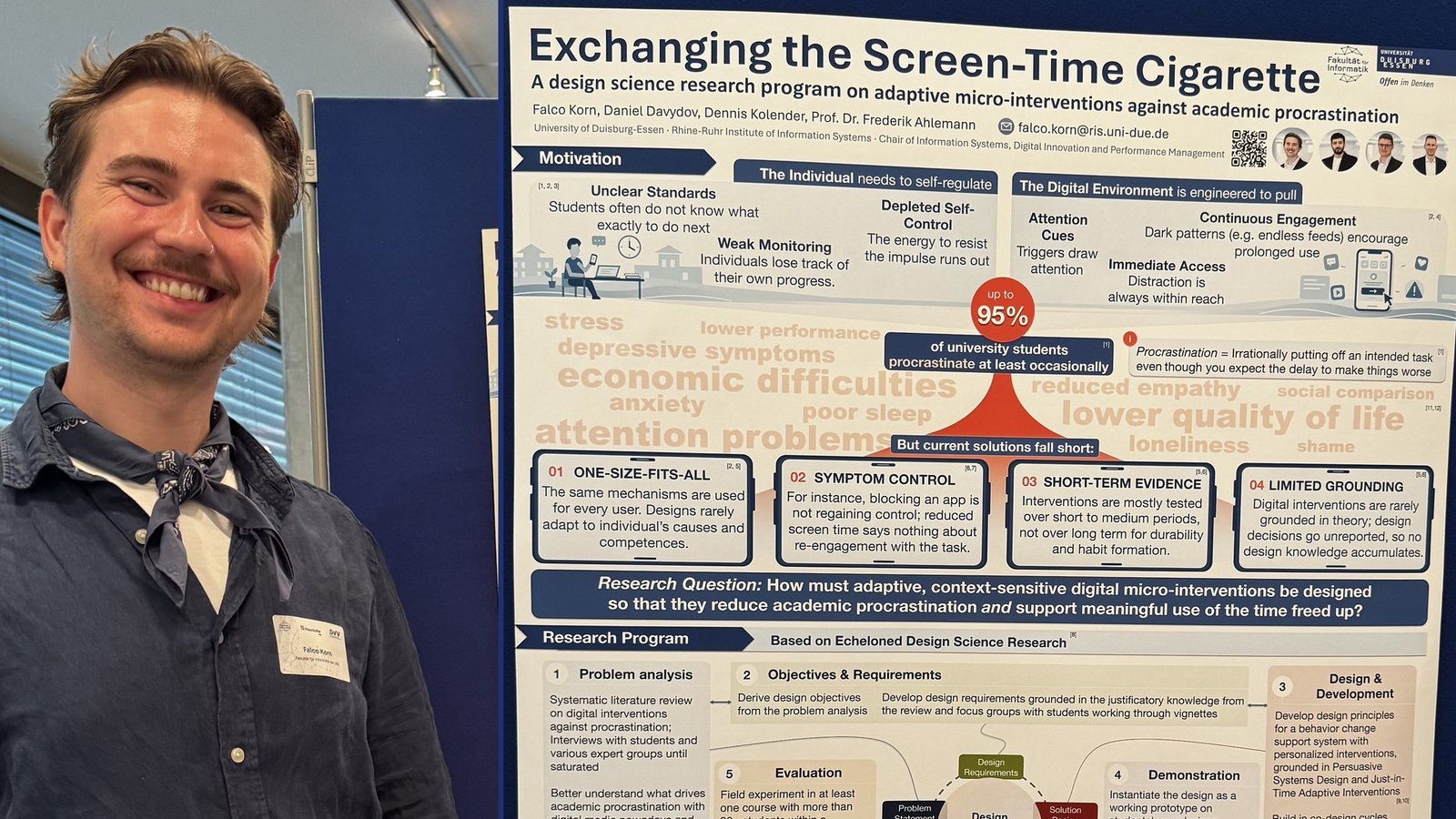
Falco Korn, a researcher at the Chair for Information Systems, Digital Innovations and Performance Management (DIP), presented the chair’s research program on adaptive digital micro-interventions against academic procrastination at the University of Duisburg-Essen’s Tag der Informatik on 29 September 2026. His poster Exchanging the Screen-Time Cigarette was part of the event’s interactive poster session, where early-career researchers from the Faculty of Computer Science shared their current work with visitors from academia, industry, and the public.
The research programme starts from a widespread problem: up to 95 percent of university students procrastinate at least occasionally. That problem is often made worse by digital environments built for continuous engagement, such as endless feeds and constant notifications. The poster argues that existing digital solutions fall short in several ways: They often follow a one-size-fits-all logic. They tend to address symptoms, for example by blocking apps, instead of helping users regain control. They rarely show effects beyond the short term. And they are seldom grounded in theory, so design knowledge does not accumulate. From this, the program asks how adaptive, context-sensitive digital micro-interventions must be designed so that they reduce academic procrastination and also support meaningful use of the time freed up. The research follows Echeloned Design Science Research and moves through several steps, such as developing design requirements, conducting interviews and testing it in a well-thought-out longitudinal experiment.
“The question isn’t only when a digital intervention should step in, but how it does so without becoming yet another source of distraction”, says Falco Korn. "Our aim is technology that helps students take back control of their attention instead of competing for it".
This year’s Tag der Informatik ran under the motto “Designed for Humans – The Future of Human-Computer Interaction” and was held at the Fraunhofer inHaus Center in Duisburg. The Faculty of Computer Science organized it together with Fraunhofer IMS. Talks by Dr. Jessica Szczuka, Dr. Gero Strobel, and Prof. Dr.-Ing. Michael Prilla looked at how AI is entering interpersonal relationships, the physical world, and human-robot teamwork. The evening closed with a get-together for exchange between research and practice.
The poster was co-authored by Falco Korn, Daniel Davydov, Dennis Kolender, and Prof. Dr. Frederik Ahlemann. The DIP team thanks the Faculty of Computer Science and Fraunhofer IMS for organizing the event, and thanks the many visitors for their questions and the lively discussions at the poster!
Aktuelles:
 From Simple Prompt to Agent: Workshop Shows SMEs How AI Can Take Over Everyday Office Routines
 Two New Papers and One Growing Collaboration for HICSS 2027
 First KI.READY Workshop on AI in Strategy Work
 Chair DIP to Deliver MasterClasses for CellPort Start-ups
- Vacant master thesis seeks to investigate and assess how municipal enterprises’ innovation culture influences the effectiveness of digital innovation activity
- One student project offered by the SITM chair in SS23
- Excellent evaluation results for the course tutorial of “Information Systems Research” in the winter semester of 2022/2023
- Chair for Information Systems and Strategic IT-Management requires a research aide
- Chair for Information Systems and Strategic IT-Management requires a student assistant
 BAS/ditlab/SITM Research Colloquium in Frankfurt