

News

Fri, 18. Sept 2026
Two New Papers and One Growing Collaboration for HICSS 2027
Strengthening collaboration across chairs and institutions is exactly the kind of momentum we're pushing for here at UDE within the Rhine-Ruhr Institute of Information Systems: two fresh acceptances at the 60th Hawaii International Conference on System Sciences (HICSS) show it in action. Prof. Dr. Frederik Ahlemann, Falco Korn and Fabian Lohmar from the Chair of Information Systems, Digital Innovation and Performance Management (DIP) teamed up with the Chair of Information Systems and Application Management (APP) lead by Prof. Dr. Mario Schaarschmidt plus team and further authors on a smart city data paper and on a study of Shadow AI in higher education. We want to hand particular credit to Mario Schaarschmidt and Ajurthan Rameskumar for pushing the papers forward.
1. “Monetizing Data Under Open Data Constraints: Startup Participation in Smart City Ecosystems” (Schaarschmidt, Mario; Ahlemann, Frederik; Rameskumar, Ajurthan; Ivens, Stefan; Woroch, Robert; Lohmar, Fabian)
Open data is supposed to be a public good — but can startups actually build a business on top of it? This paper digs into the tightrope that data-driven startups walk in smart city ecosystems, caught between regulatory mandates to keep data open and the commercial pressure to monetize it. Rather than treating the two as irreconcilable, the study maps out how startups navigate — and sometimes exploit — this tension, offering policymakers concrete cues for designing open data frameworks that don't quietly starve out the entrepreneurial layer they're meant to support.
2. “How Is Shadow AI Legitimized in Higher Education? A Qualitative Study Among Academic Educators in the Absence of Institutional Guidance” (Rameskumar, Ajurthan; Korn, Falco; Khosrawi-Rad, Bijan; Schaarschmidt, Mario)
Generative AI has landed in university classrooms faster than any policy could keep up with — and educators are quietly making their own rules. This qualitative study gets inside that gap, asking how academic staff justify and rationalize their AI use when there's no institutional playbook to point to. The result is a close-up look at the informal legitimization strategies emerging in real time, and a set of practical starting points for universities scrambling to catch up with guidance that's actually usable.
--
The HICSS is one of the longest-running international academic conferences in the field of information systems and brings together researchers from various disciplines each year to discuss current developments and research findings related to information systems and digital technologies. We wish our co-authors and presenters the very best of luck and unforgettable impressions at HICSS!
Latest News:
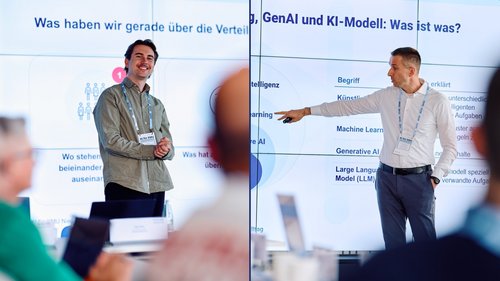 From Simple Prompt to Agent: Workshop Shows SMEs How AI Can Take Over Everyday Office Routines
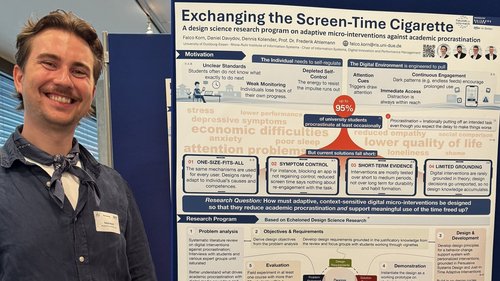 DIP Presents Research Program on Adaptive Micro-Interventions at Tag der Informatik
 First KI.READY Workshop on AI in Strategy Work
 Chair DIP to Deliver MasterClasses for CellPort Start-ups
- Vacant master thesis seeks to investigate and assess how municipal enterprises’ innovation culture influences the effectiveness of digital innovation activity
- One student project offered by the SITM chair in SS23
- Excellent evaluation results for the course tutorial of “Information Systems Research” in the winter semester of 2022/2023
- Chair for Information Systems and Strategic IT-Management requires a research aide
- Chair for Information Systems and Strategic IT-Management requires a student assistant
 BAS/ditlab/SITM Research Colloquium in Frankfurt